




Gymnastics Ribbons - How to Choose The Right One?
A complete guide to ribbon lengths, materials, colours and ribbon sticks for training and competition
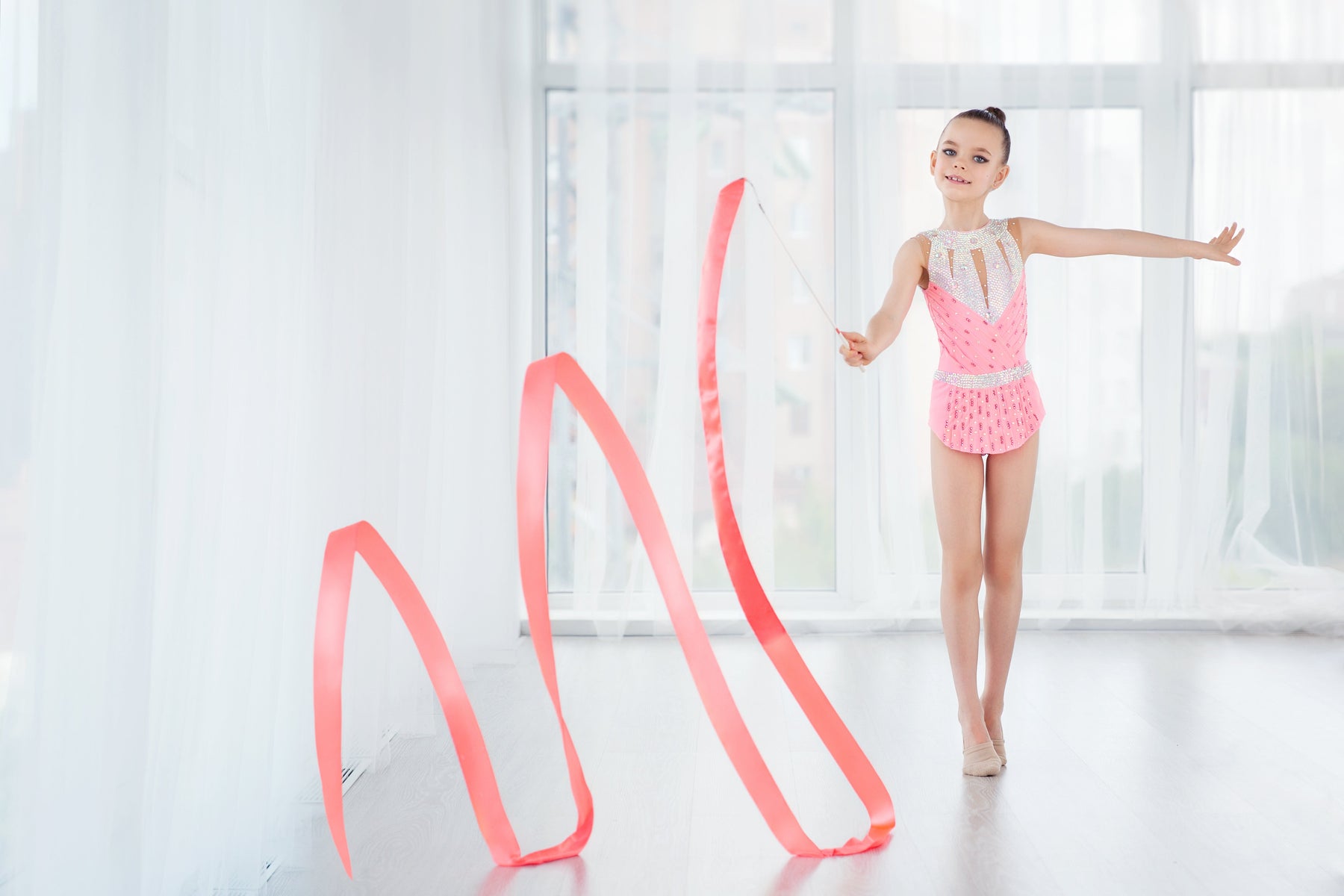
The ribbon is one of the most visually spectacular apparatus in rhythmic gymnastics — and one of the trickiest to get right. Too short and the patterns look small. Too long and a young gymnast will struggle with control. The wrong material tangles. The wrong stick length throws off the balance.
This guide explains how to choose the correct ribbon length for your gymnast's age and level, what to look for in materials and construction, how to pair a ribbon with the right stick, and how to care for both — with links to every ribbon and stick we mention.
Shop ribbonsShop ribbon sticks
How long is the ribbon in rhythmic gymnastics?
Rhythmic gymnastics ribbons come in three standard lengths: 4 metres, 5 metres and 6 metres. The correct length depends on the gymnast's age and competition level.
4-metre ribbons
Four-metre ribbons are designed for the youngest gymnasts — typically those aged 10 and under, or those training recreationally. The shorter length is easier to control, making it ideal for learning basic ribbon skills like spirals, snakes, circles and throws. Most 4m ribbons are not FIG-approved, as they are intended for training and early development rather than formal competition.
CHACOTT Junior Ribbon Single Colour – 4 mPASTORELLI Uni-Colour Ribbon – 4 mVENTURELLI Practice Ribbon
5-metre ribbons
Five metres is the minimum ribbon length for junior gymnasts under the FIG Apparatus Norms, and it is also used by many younger competitive gymnasts. Exact age groups vary by federation and competition.
6-metre ribbons
Six metres is the minimum ribbon length for senior gymnasts under the FIG Apparatus Norms, used at senior national and international competition.
Chacott's single-colour and Gradation ribbons are FIG-approved and available in both 5 m and 6 m; Sasaki's ribbons are FIG-approved at competition lengths.
CHACOTT Ribbon Single Colour – 5 m and 6 mCHACOTT Ribbon Gradation – FIG-approvedSASAKI Single-Colour Ribbon – FIG-approved
Quick length guide
| Age / Level | Ribbon length | Typical use |
|---|---|---|
| 10 and under / recreational | 4 m | Training, beginner classes, early development |
| Junior competition | 5 m | Junior and younger competitive gymnasts |
| Senior competition | 6 m | Senior national and international competition |
Important: These are general guidelines. Age rules can vary between federations and competition levels. Always check with your coach or club before buying a competition ribbon to confirm which length is required.
What makes a good rhythmic gymnastics ribbon?
Not all ribbons are equal. At competition level, even small differences in weight, weave and stiffness change how the ribbon moves through the air. Here is what to look for.
Weight
Lighter ribbons produce bigger, more flowing shapes. The FIG minimum weight for a senior ribbon is 35 grams, and the best competition ribbons sit just above this minimum. Heavier ribbons feel sluggish and produce smaller patterns.
Material and weave
Competition ribbons are made from a satin-like woven fabric — not the thick, stiff fabric you sometimes see on cheap recreational ribbons. The weave needs to be fine enough to keep the weight down but strong enough to withstand throws, catches and rapid changes of direction.
Chacott ribbons are produced with antistatic thread, which reduces the static cling that can cause a ribbon to stick to itself or to the gymnast during a routine — useful in dry indoor sports halls. Pastorelli ribbons are woven using a traditional technique that prioritises lightness.
Colour and pattern
Ribbon colour is more than decoration. At competition, judges need to see the ribbon clearly throughout the routine, so vivid, saturated colours read better than pale or muted tones. Most brands offer ribbons in three styles:
- Uni-colour — a single solid colour throughout. Clean and classic, in a huge range of shades.
- Multi-colour / gradation — two or more colours blending along the ribbon, such as Chacott's Gradation and Sasaki's High Pitch and Art Gradation ribbons. Striking under competition lighting and popular for matching leotards.
- Metallic or holographic accents — some ribbons feature metallic thread or a subtle shimmer. Check FIG regulations, as some finishes may not be approved for all competitions.
Many gymnasts choose ribbon colours that complement their leotard and music for a cohesive overall presentation.
Ribbon brands compared
Chacott
Japanese brand Chacott produces ribbons known for antistatic thread and smooth movement through the air. Gymnamo is an official Chacott distributor for the UK and Ireland, so we buy direct from Chacott in Japan and keep the range in stock here.
- Junior Ribbon Single Colour, 4 m — for younger gymnasts and training.
- Ribbon Single Colour, 5 m and 6 m — FIG-approved, solid colours.
- Ribbon Gradation — FIG-approved, colour blends along the ribbon.
- Ribbon Infinity, 6 m — FIG-approved senior ribbon.
- Double Training Ribbon — a training ribbon.
How Chacott compares on price: Chacott's Gradation ribbon is priced below Sasaki's gradation ribbons, its single-colour FIG ribbon is level with Sasaki's, and its junior 4 m ribbon is level with Pastorelli's. See the price table below.
CHACOTT Ribbon GradationCHACOTT Ribbon Single Colour – 5 m / 6 mCHACOTT Ribbon Infinity – 6 m
Sasaki
Sasaki offers two standout gradation lines: the Art Gradation ribbon, prized for its colour transitions, and the High Pitch Gradation, a favourite for its performance feel. Both are FIG-approved at competition lengths, alongside Sasaki's single-colour ribbons.
Sasaki High Pitch GradationSasaki Art Gradation
Pastorelli
A long-standing name in competitive rhythmic gymnastics, Pastorelli is known for lightweight ribbons and vivid colours. We currently stock Pastorelli's 4 m uni-colour ribbon for junior gymnasts.
Price guide by ribbon and stick type
| Type | Chacott | Sasaki | Pastorelli | Venturelli / Amaya |
|---|---|---|---|---|
| Junior ribbon, 4 m | around £18 | — | around £18 | practice ribbon around £25 |
| Single-colour ribbon, 5–6 m (FIG) | around £27 | around £26 | — | — |
| Gradation ribbon (FIG) | around £35 | £42–£50 | — | — |
| Premium senior ribbon, 6 m (FIG) | around £53 (Infinity) | — | — | — |
| Ribbon sticks | £47–£54 | £43–£55 | £43–£47 | £15–£44 |
Typical prices, October 2026. Exact prices are on each product page.
Choosing a ribbon stick
Every ribbon needs a stick (also called a wand), and getting the right one matters as much as getting the right ribbon. Ribbon and stick are sold separately, so you need to match them correctly.
Stick length
| Ribbon length | Stick length | Typical user |
|---|---|---|
| 4 m | 50 cm | Juniors / recreational |
| 5 m | 50–57 cm | Junior competition |
| 6 m | 57–60 cm | Senior competition |
FIG regulations specify minimum and maximum stick dimensions for competition use. Always check the product description for FIG approval if your gymnast competes.
Stick materials
Most competition-grade ribbon sticks have a fibreglass or carbon fibre shaft with a rubber or plastic grip. Fibreglass is the standard — lightweight, flexible and durable. Carbon fibre sticks are even lighter but more expensive. The attachment at the tip (a small swivel or clip) connects the ribbon and lets it rotate freely.
Sticks we stock
CHACOTT RG Stick HOLOGRAMCHACOTT Gradient StickSASAKI Glass Ribbon StickPASTORELLI Ribbon Stick with GlitterAMAYA RG Beginner Ribbon Stick – 54 cm
Caring for your ribbon and stick
Ribbon care
Ribbons are delicate by design — their lightness is what makes them perform well, but it also means they need careful handling.
Storage: Always wind your ribbon onto a ribbon winder after use. Leaving a ribbon loose in a bag causes creasing and tangling that can be difficult to undo.
Ironing: If your ribbon is creased, you can iron it on the lowest temperature setting using a cloth between the iron and the ribbon. Never iron a ribbon directly — the heat will damage the fabric.
Washing: Most competition ribbons are not washable. Avoid getting them wet. If the ribbon gets dirty, a gentle wipe with a barely damp cloth is the safest approach.
Replacing: Ribbons wear out with use. The attachment end — where the ribbon connects to the stick — takes the most stress and may need re-stitching over time. When a ribbon becomes frayed, stiff or has lost its shape, it is time for a new one.
Stick care
Ribbon sticks are more durable than ribbons, but the attachment and swivel can wear. Check the tip regularly to make sure the swivel rotates freely, and replace the stick if the shaft cracks or the grip becomes loose.
Frequently asked questions
Can I use any ribbon with any stick? Yes, in most cases. Ribbons attach to sticks via a standard clip or loop. Always match your stick length to your ribbon length (see the table above).
How often do ribbons need replacing? It depends on how often your gymnast trains. A competitive gymnast training daily might go through a ribbon every 2–4 months. A recreational gymnast training once or twice a week could get 6–12 months from a ribbon.
Can my gymnast use a 6 m ribbon at age 12? For training, yes — practising with a longer ribbon builds strength and control. For competition, the correct length is set by federation rules. Check with your coach.
Do ribbon colours matter for competition? There is no rule specifying ribbon colour, but bright, vivid colours help judges see the ribbon clearly.
Ordering for a club or group? Group routines need matching ribbons. Get in touch and we will help you put together a matching set at our club price.
Shop ribbons and ribbon sticks
We stock 4 m, 5 m and 6 m ribbons from Chacott, Sasaki and Pastorelli, plus sticks from all major brands. Most orders are dispatched within 1–2 working days from our UK base.
Shop ribbonsShop ribbon sticks
Need help choosing? Get in touch — we are always happy to help.